
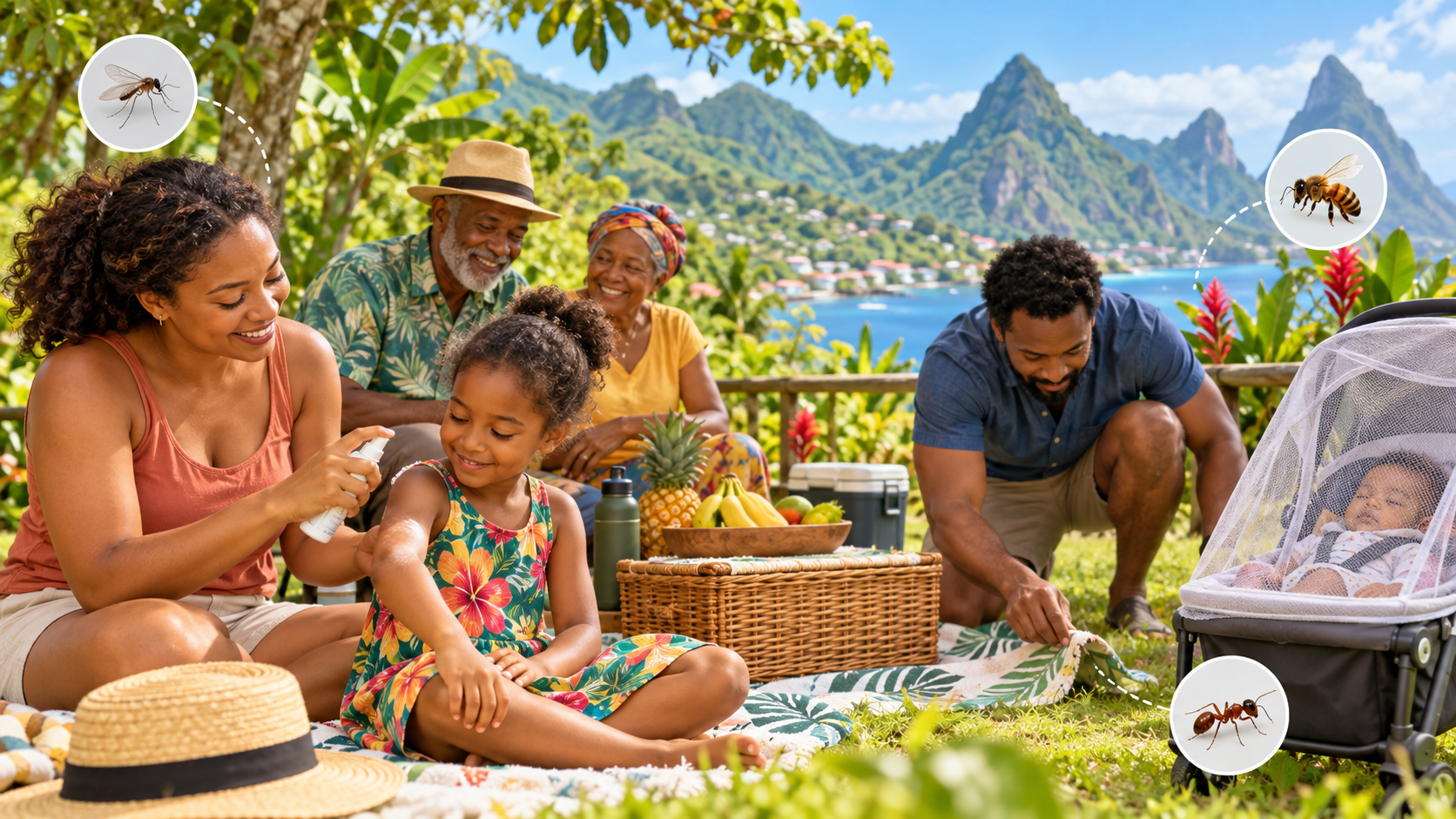
Dominica’s warm climate, lush vegetation, beaches, rivers and outdoor gathering places are part of what will make our family reunion so enjoyable. They also mean that we should expect to share some of those spaces with insects.
For most of us, midges, bees and ants are nuisances rather than serious dangers. A little preparation can prevent many bites and stings and make our outdoor activities much more comfortable.
These recommendations are intended as normal precautions for the whole family — adults, children and babies. Anyone with a known serious allergy to insect stings should, of course, follow the individualized advice of their healthcare provider.
1. Midges — the Tiny Biters You May Not See
Midges, particularly the biting varieties often called “no-see-ums,” are extremely small flying insects. Some are only about one millimetre long. They can be especially troublesome around coastal areas, moist ground, mangroves, wetlands and other places where their immature stages can develop.
Many biting midges are most active around dawn and dusk, although some species will bite at other times. Their bites can cause a small burning or stinging sensation followed by redness and itching.
Adults
When we are spending time outdoors:
- Use an insect repellent that is labelled for protection against biting insects.
- Apply repellent to exposed skin according to the product directions.
- Lightweight long trousers and long-sleeved shirts provide additional protection when midges are particularly active.
- Around dawn and dusk, especially in sheltered areas with little breeze, be a little more attentive to insect protection.
Repellents containing ingredients such as DEET or picaridin are commonly used for protection against biting insects. Follow the product label carefully rather than assuming that more repellent provides better protection.
Young Children
Children can use appropriate insect repellents, but an adult should apply them.
Rather than spraying repellent directly onto a child's face, adults should first put a small amount onto their own hands and then gently apply it to the child's exposed skin. Avoid the eyes, mouth, hands, cuts and irritated skin.
Clothing also provides useful protection, particularly light long sleeves and trousers when practical.
For products containing oil of lemon eucalyptus (OLE) or PMD, parents should pay particular attention to age restrictions on the label; some such products should not be used on children under three.
Babies
Babies need somewhat different protection.
For infants younger than two months, CDC guidance recommends not applying insect repellent directly to the baby's skin. Instead, use physical protection such as lightweight clothing and properly fitted insect netting over a stroller, carrier or infant seat.
Make certain that netting:
- completely covers the opening,
- is secured so insects cannot enter,
- remains away from the baby's face, and
- still allows good airflow.
This is one reason families travelling with very young babies may want to include a good-quality stroller or carrier insect net among their reunion supplies.
If Someone Is Bitten
Most midge bites simply need ordinary care. Wash the area, avoid scratching and use a cool compress if necessary. Scratching can break the skin and increase the possibility of infection.
2. Bees — Usually Best Left Alone
Bees play an important role in tropical environments and generally have little interest in interfering with our reunion. Most stings happen when a bee is accidentally disturbed, trapped against the skin or feels that its nest is threatened.
The simplest rule is therefore:
See a bee? Give it some space.
Adults should discourage children from swatting at bees or trying to catch them.
Food and sweet drinks can also attract bees and other flying insects, so outdoor dining areas should be kept reasonably tidy.
Adults
Around picnic areas and outdoor meals:
- Keep food covered when practical.
- Wipe up sugary spills promptly.
- Look before drinking from an open bottle or can that has been sitting outside.
- Avoid walking barefoot through flowering grass.
- Do not disturb nests or clusters of insects.
If a bee approaches, calmly move away rather than swatting vigorously at it.
Young Children
Children are naturally curious about insects, so a little advance explanation helps.
Teach them a simple rule: look, but do not touch.
Adults should also check children's open cups, juice containers and food if they have been left unattended outdoors.
Shoes or sandals are advisable in grassy areas because bees may sometimes be feeding on low-growing flowers.
Babies
The principal protection for babies is environmental:
- keep the baby's immediate area free of uncovered sweet food and drinks;
- do not position a stroller immediately beside flowering plants where bees are actively feeding;
- use stroller netting when flying insects become bothersome.
There is generally no need to apply insect repellent specifically for bees. Repellents used against mosquitoes and midges should not be regarded as a substitute for sensible bee avoidance.
If Someone Is Stung
For an ordinary bee sting:
- Move away from the area so that another sting is less likely.
- Remove a visible stinger promptly.
- Wash the area with soap and water.
- Apply a cold compress or wrapped ice pack for about 10–20 minutes to reduce discomfort and swelling.
Most uncomplicated stings cause temporary pain, redness and swelling and improve without medical treatment.
However, difficulty breathing, swelling of the face, lips, tongue or throat, faintness, widespread hives or other signs of a severe systemic reaction require immediate emergency medical attention.
That warning applies even to someone who has never previously been diagnosed with an insect allergy.
3. Ants — Watch Where We Sit, Stand and Put Our Food
Ants are another normal part of a tropical environment. Most are simply looking for food and cause no problem at all.
The greatest opportunities for encounters arise around:
- picnic areas,
- food scraps,
- sweet drinks,
- fallen fruit,
- grassy areas,
- tree roots,
- rocks and logs, and
- places where bags, towels or blankets have been placed directly on the ground.
Some ants can bite or sting, so prevention is largely a matter of paying attention to the ground around us.
Adults
Before spreading out a picnic blanket or setting down bags:
- take a quick look for visible ant trails or nests;
- avoid positioning the family directly on an ant mound;
- keep food containers closed when they are not being used;
- clean up dropped food promptly;
- shake out towels, clothing and bags that have been sitting on the ground.
Footwear also provides very simple protection.
If you see numerous ants moving in a concentrated line or emerging from a particular patch of soil, choose another spot rather than attempting to disturb them.
Young Children
Children spend more time close to the ground and may not notice ants as quickly as adults.
Before allowing children to sit or play:
- inspect the immediate area;
- check around blankets and picnic mats periodically;
- keep snacks reasonably contained;
- encourage children to tell an adult if they feel insects crawling on them rather than brushing wildly at the area.
Sandals or closed shoes are useful when walking through grassy or unfamiliar areas.
Babies
Babies deserve particular attention because they cannot tell us that ants are crawling onto a blanket or stroller.
Before putting a baby down:
- inspect the ground carefully;
- use a clean mat or blanket rather than placing the child directly on grass or soil;
- periodically check the edges and underside of the mat;
- avoid setting a stroller directly over an ant trail or mound;
- keep bottles and food residue cleaned up.
The same principle applies to diaper bags, carriers and other baby equipment left on the ground: check before picking them up and placing them near the baby.
If Someone Is Bitten or Stung
Move away from the ants first.
Some stinging ants hold onto the skin, so brush or rub them off promptly. Wash the affected area and use a cool compress for discomfort or swelling.
Certain ant stings can produce burning, redness and small raised areas. CDC occupational guidance for fire-ant stings likewise recommends removing attached ants promptly and seeking urgent medical care for serious systemic symptoms.
Avoid scratching itchy bites, particularly in young children, because broken skin can become infected.
A Simple Family Protection Routine
We do not need to turn our reunion into an insect-control exercise. A few habits will cover most situations.
Before heading out: bring appropriate repellent, drinking water, sunscreen, footwear and — for babies — stroller or carrier netting.
When arriving somewhere: take a quick look at where you are sitting, particularly before putting blankets, bags or babies on the ground.
During outdoor meals: keep food covered where practical, clean spills and avoid leaving sweet drinks open for long periods.
Around dusk: remember that biting midges and other small flying insects may become more noticeable, so this is a good time to check whether repellent needs to be reapplied according to its label.
At the end of the day: wash treated skin as appropriate, check children for bites and avoid excessive scratching.
One Important Distinction
Our reunion guidance treats insect protection as an ordinary family comfort and safety matter.
People who already know that they have a serious allergy to bee, wasp, hornet or ant stings have additional medical considerations that go beyond these general precautions. They should travel with whatever medication and emergency plan their healthcare provider has prescribed.
For everyone else, the objective is much simpler:
protect exposed skin, watch where we sit and walk, keep food areas tidy, give bees their space — and get on with enjoying Dominica together.
This article provides general family-travel information and does not replace individualized medical advice.



0 Comments